Passage Excerpt and Question
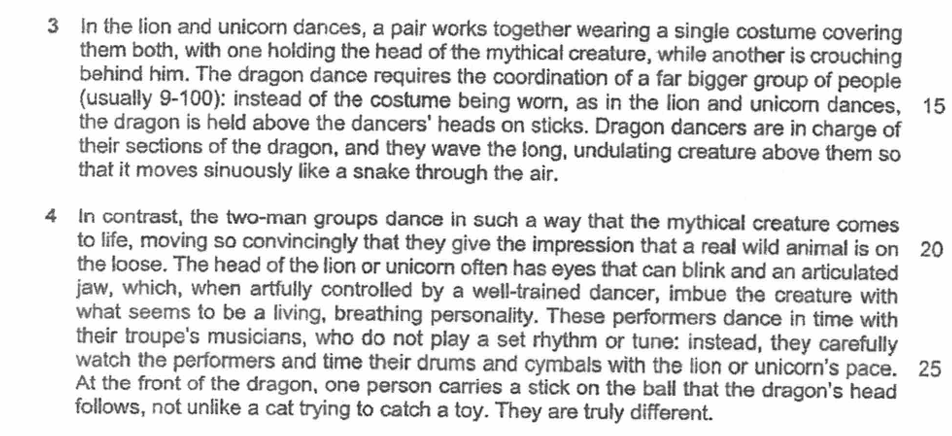
Using your own words as far as possible, summarise how lion and unicorn dances are different from dragon dances. Use only information from Paragraphs 3 to 4 of Text 4.
Suggested Organisation
I recommend you group the pointers about lion/unicorn dances in one block, followed by the dragon dances.
Both are highly discrete, which facilitates this form of organisation. Additionally, the comparisons are not exactly apple-to-apple. For instance, the lion/unicorn dances reference musicians, while the dragon dance does not. Grouping the points for the same category together here will save you time and word count expended on signposting every single comparison.
Sample Summary
Cultural dances such as lion and unicorn dances would require two performers teaming up, sharing one costume. One handles its head while another crouches behind. Together, they perform to make the legendary beast appear realistic. These skilful performers manipulate its facial features to portray its character.
Meanwhile, dragon dances need significantly more performers to work together. The dragon costume is raised on sticks above the dancer’s heads. Dancers manipulate their dragon segments to create snake-like movements as it follows a ball on a stick led by someone moving in front.
This sample has 79 words. Paragraphing is added here for ease of reading. The summary should be written as a single paragraph in your paper.
Summary Points
A: Lion and unicorn dances; B: Dragon dances
| No. | Passage | Rephrased |
| A: Lion and unicorn dances | ||
| A1 | In the lion and unicorn dances, a pair works together wearing costume covering them both | Two performers/dancers teaming up, in/sharing one costume. Explanation: Context must be given for the “pair” – that it is two performers specifically. |
| A2 | with one holding the head of the mythical creature, while another is crouching behind him. | One handles its head while another crouches behind. Explanation: “Its” has the context of belonging to the costume already. You can drop the mention of the “mythical creature”. You will also need to mention “performers” (“One performer handles”) if you have not already set prior context, such as by skipping point A1. |
| A3 | the two-man groups dance in such a way that the mythical creature comes to life, moving so convincingly that they give the impression that a real wild animal is on the loose. | Together, they perform to make the legendary beast seem/appear wild/alive/realistic. Explanation: “Dance in such a way” can be distilled into the verb, “perform”, since it is a show. “Give the impression” is paraphrased to “seem” or “appear”. Note that I am not inclined to accept “impersonate” or any word with the meaning of “pretence”. It has the implication of “assuming the identity of something they are not”, which is not the case here. These performers are merely portraying a beast, showing what it is like. |
| A4 | The head of the lion or unicorn often has eyes that can blink and an articulated jaw, which, when artfully controlled by a well-trained dancer, imbue the creature with what seems to be a living, breathing personality | These skilful performers manipulate its eye and jaw movements / facial features / head movements to reflect/portray its character. Explanation: This sentence can get complicated. My tip is to rewrite the sentence into a simpler one with a clear focal subject in it. The past points have focused on the dancers/performers, so this is the most apparent choice. After that, we show what these dancers do (artfully controlled >> manipulated), and the objects they are controlling. The last part of this sentence is where we state the purpose of this performance. |
| A5 | These performers dance in time with their troupe’s musicians, who do not play a set rhythm or tune: instead, they carefully watch the performers and time their drums and cymbals with the lion or unicorn’s pace. | Troupe musicians/instrumentalists match their music/performance to the costume performers’ movements. OR (if directly following A4) While dancing/performing to the music from musicians/instrumentalists based on their movements/pace. Explanation: Rewrite this sentence structure to focus on a fixed subject (“[Subject] does [Action]”). Two approaches can be made here – either by focusing on troupe musicians, or troupe performers to do so. |
| B: Dragon dances | ||
| B1 | The dragon dance requires the coordination of a far bigger group of people (usually 9-100): | (However), dragon dances need significantly/many more performers to work together/collaborate. Explanation: Do add conjunctions to indicate that you are moving to the next part of your summary. We use “however” to show that there is a contrast in the two different dances. Specific details like the dancers needed are not required. |
| B2 | Instead of the costume being worn, as in the lion and unicorn dances, the dragon is held above the dancers’ heads on sticks. | The dragon costume is placed/put/raised on sticks above the dancer’s heads. Explanation: This point requires a restructuring of the sentence. Again, we make something the focal point (“dragon costume”) and show what happens to it with the rest of the simplified sentence. |
| B3 | Dragon dancers are in charge of their sections of the dragon. | Dancers manipulate/manage/wave their dragon segments/parts/positions Explanation: Use the appropriate synonym to substitute the relevant parts of the passage. |
| B4 | and they wave the long, undulating creature above them so that it moves sinuously like a snake through the air. | [Performers move the dragon above them] to create snake-like/twisting/curving movements. Explanation: The portion in square brackets should be included if there is no context on who is waving the costume (such as by skipping point B3). |
| B5 | At the front of the dragon, one person carries a stick on the ball that the dragon’s head follows, not unlike a cat trying to catch a toy. | (As) the dragon follows a ball on a stick led by someone moving in front Explanation: Rewrite this sentence to be more concise |